
How to Make Change in Infinite Craft Step By Step Guide
How to Make Change in Infinite Craft: The Ultimate Crafting Guide
Infinite Craft, the captivating browser game by Neal Agarwal, presents a universe of possibilities where you start with just four basic elements: Earth, Wind, Fire, and Water. The joy of the game lies in discovering how to combine these primaries to create everything from simple concepts to complex pop culture icons.
One of the most fundamental and philosophically intriguing elements you can create is Change. Mastering this element is a key step in unlocking countless other discoveries. This guide will provide a clear, step-by-step path to crafting Change and explain its significance within the game’s infinite world.
Understanding the Core Mechanics of Infinite Craft
Before we delve into the specific recipe, it’s crucial to grasp how the game works. Essentially, Infinite Craft is an alchemical sandbox. You drag and drop two elements together, and if they are compatible, they produce a new, third element. This new element is then added to your palette for future use. The process is one of experimentation and logical (or sometimes whimsical) association.
The ultimate goal is to chain these combinations to create increasingly sophisticated items, from “Philosophy” to “Skyscraper” to “Godzilla.” Consequently, understanding elemental relationships is paramount. For instance, combining Fire and Water logically creates Steam. This foundational logic is your key to unlocking Change.
The Step-by-Step Recipe to Craft Change
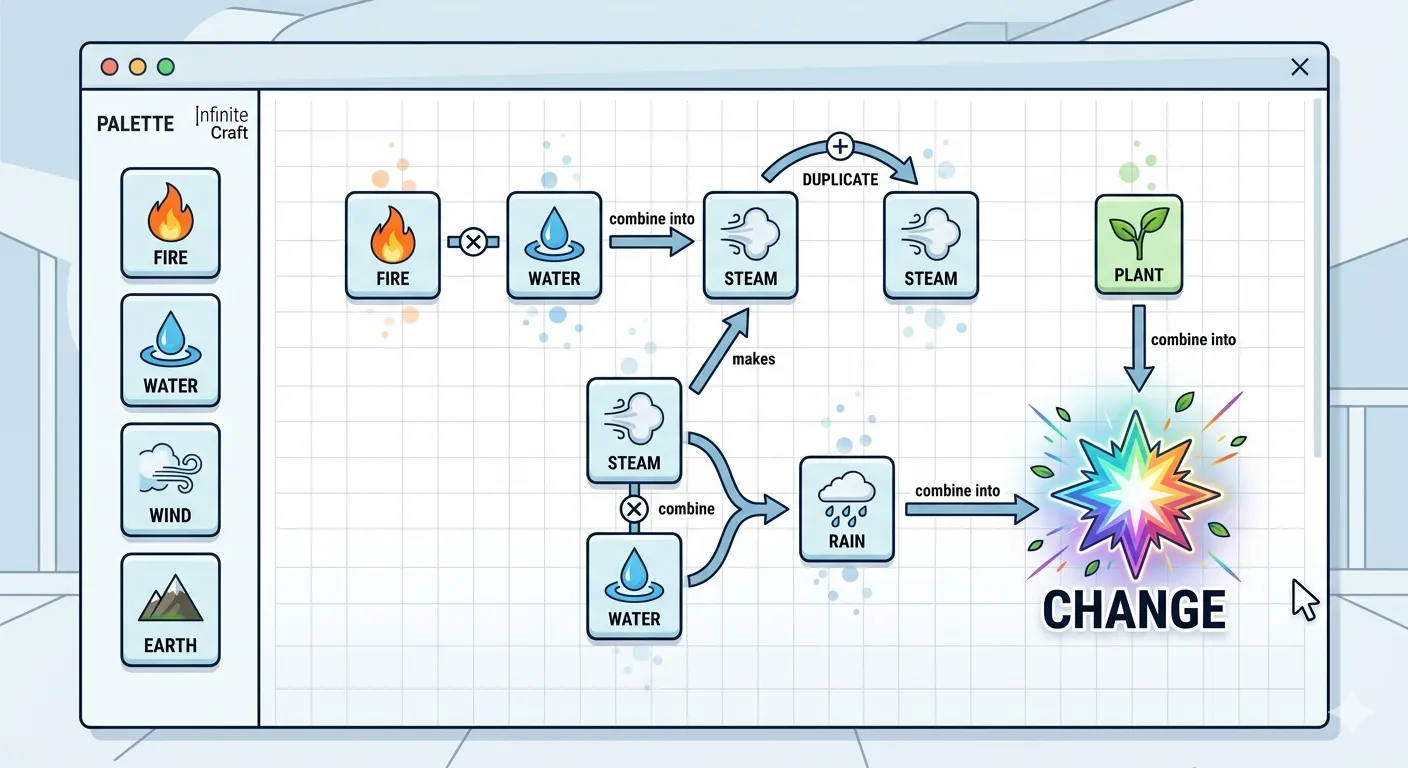
The element “Change” is not created from the basic four elements directly. Instead, it requires a short chain of combinations that introduces the concept of time and transformation. Here is the most straightforward and reliable recipe:
- Combine Fire and Water to create Steam.
- This is one of the first and most classic combinations in the game. It represents a fundamental transformation of state.
- Combine Earth and Water to create Plant.
- This combination symbolizes growth and life, another form of natural change.
- Combine Steam and Steam to create Cloud.
- Doubling up on Steam condenses the concept into a new form, showing progression.
- Combine Cloud and Water to create Rain.
- This is a natural meteorological cycle, a clear depiction of change in the environment.
- Finally, combine Rain and Plant to create Change.
- This is the pivotal combination. The rain nourishes and alters the plant, perfectly encapsulating the idea of transformation and, therefore, Change.
Quick Reference Crafting Table
For visual learners, here is a table outlining the direct path:
| Step | Combination | Result |
|---|---|---|
| 1 | Fire + Water | Steam |
| 2 | Earth + Water | Plant |
| 3 | Steam + Steam | Cloud |
| 4 | Cloud + Water | Rain |
| 5 | Rain + Plant | Change |
Why is the Change Element So Important?
Creating Change is more than just checking off an item on a list. It serves as a critical gateway element for countless advanced recipes. Once you have Change in your inventory, you can begin to explore abstract and meta-concepts.
For example:
* Change + Philosophy could lead to Revolution or Enlightenment.
* Change + Time is a powerful duo for creating elements related to evolution, history, or aging.
* Change + Human might result in Progress or Innovation.
Think of Change as a versatile tool. It acts as a catalyst, modifying the meaning of other elements you combine it with, much like how real-world change drives innovation and new discoveries. This principle of using foundational elements to build complex ideas mirrors processes in other fields; for instance, understanding how to use specific herbs or supplements for health requires knowing their base components and effects, similar to our guide on the potential benefits of green tea for hormone imbalance.
Pro Tips and Strategies for Infinite Discovery
- Experiment Relentlessly: The documented recipe is the fastest route, but Infinite Craft often has multiple paths to the same element. Don’t be afraid to try Rain with other growth-related elements.
- Use Your First Discovery of Change Wisely: Once crafted, immediately try combining Change with other basic and intermediate elements you have. It’s a fantastic way to unlock a burst of new discoveries.
- Think Abstractly: Elements like Change, Time, Life, and Death are conceptual. Combine them with physical elements (Mountain, River, City) to create stories or historical events.
- Chain Your Creations: The element you create might be a component for something else you’ve been trying to make. Always revisit old elements with new ones. This systematic approach to combining components is akin to crafting a specific wellness regimen, such as determining the best time to take omega-3 for weight loss to optimize its effects.
- Embrace the “Infinite”: There is no true end. If you feel stuck, go back to the basics and combine them in new orders. The community is always discovering new, surprising chains.
Conclusion: Your Journey Has Just Begun
Successfully crafting Change in Infinite Craft is a rewarding milestone that opens the door to the game’s deeper, more philosophical layers. It validates your understanding of the game’s internal logic and provides a powerful new component for your creative toolkit. Remember, the process of discovery—the trial, error, and eureka moments—is the core joy of the game.
Therefore, with Change now in your possession, you are perfectly equipped to alter your virtual world in endlessly surprising ways. Start combining, and see what you can transform next!
For more information on the concepts of emergence and generative systems that power games like Infinite Craft, you can explore the topic on Wikipedia.

