
Cargo Craft: Types & Modern Logistics
The Essential Guide to Cargo Craft: Powering Global Trade
When you think of the products in your home—from electronics to food—chances are they traveled on a cargo craft at some point. These specialized vehicles are the unsung heroes of global commerce, forming the backbone of international supply chains. Consequently, understanding their types and functions reveals the complex dance of modern logistics that delivers goods to your doorstep.
What is a Cargo Craft?
A cargo craft is any vehicle or vessel specifically designed for the transport of goods, materials, and merchandise. Unlike passenger vehicles, their primary function is commercial freight movement. They operate across all domains: sea, land, air, and even space. Moreover, their design prioritizes capacity, efficiency, and the safe handling of diverse cargo types, from perishable foods to heavy machinery.
Major Types of Cargo Craft and Their Roles
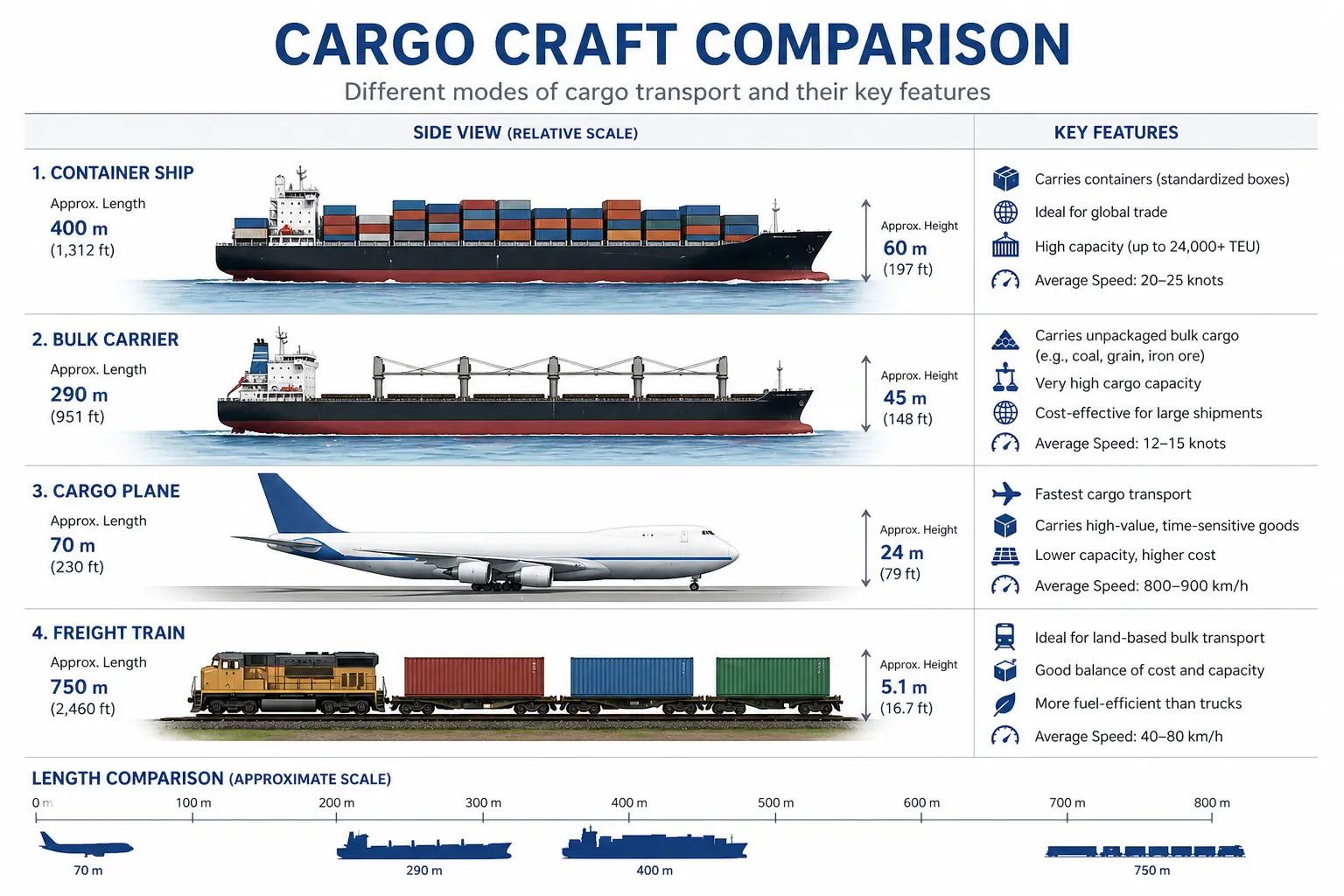
The world of freight transport is diverse. Here’s a breakdown of the primary cargo craft categories that keep our global economy moving.
1. Maritime Cargo Vessels
Maritime transport handles over 80% of global trade by volume, making it the most dominant mode.
| Type of Vessel | Primary Cargo | Key Characteristics |
|---|---|---|
| Container Ship | Standardized containers | Efficient, modular; the workhorse of global trade. |
| Bulk Carrier | Unpacked bulk goods (e.g., grain, coal, ore) | Large hatches for direct loading into cargo holds. |
| Tanker | Liquid bulk (e.g., oil, chemicals) | Specialized piping and pump systems for liquid transfer. |
| Roll-on/Roll-off (RoRo) | Wheeled cargo (e.g., cars, trucks) | Built-in ramps for vehicles to drive on and off. |
| General Cargo Ship | Breakbulk, non-containerized goods | Multiple decks and cargo holds for varied items. |
2. Air Cargo Aircraft
Air freight is the fastest option, crucial for high-value, perishable, or time-sensitive goods.
| Type of Aircraft | Common Use Cases | Advantage |
|---|---|---|
| Freighter Aircraft | Dedicated freight routes (e.g., Boeing 747F) | Large main deck doors and reinforced floors. |
| Passenger-Freighter Combi | Mixed passenger and cargo on main deck | Flexibility for airlines. |
| Regional Turboprops | Short-haul, smaller parcel networks | Access to smaller airports with shorter runways. |
3. Land-Based Cargo Craft
This category includes the trucks and trains that facilitate “first and last mile” delivery.
- Freight Trucks & Semi-Trailers: The most visible form, enabling door-to-door delivery. They often carry goods that first arrived on a larger vessel.
- Freight Trains: Exceptionally efficient for moving heavy bulk commodities or intermodal containers over long land distances.
The Critical Importance in Modern Supply Chains
Cargo craft are more than just transporters; they are integral to economic stability and consumer access. Firstly, they enable globalization by making it cost-effective to manufacture products in one region and sell them worldwide. Additionally, they support just-in-time manufacturing, where parts arrive precisely when needed, reducing inventory costs. Furthermore, specialized vessels are vital for food security, transporting staples like grain and jasmine vs basmati rice across continents.
However, this system faces challenges. Port congestion, fuel price volatility, and geopolitical events can disrupt the flow. Therefore, logistics companies constantly optimize routes and cargo mixes to improve resilience.
Specialized Cargo and Niche Transport
Beyond standard boxes and bulk, some cargo craft handle unique demands:
- Reefer Vessels/Containers: Temperature-controlled transport for perishables like pharmaceuticals, dried medjool dates, or fresh fruit.
- Heavy-Lift Vessels: Equipped with massive cranes to transport other ships, oil rigs, or industrial modules.
- Livestock Carriers: Specially designed with ventilation and welfare systems for transporting animals.
Frequently Asked Questions (FAQs) – Cargo Craft
1. What is cargo craft?
Cargo craft can refer to cargo transport vehicles, cargo aircraft, cargo ships, or specially designed utility craft used to move goods.
2. What types of cargo craft are there?
Common types include cargo planes, cargo ships, delivery vans, freight trucks, and space cargo craft.
3. What is a cargo aircraft?
A cargo aircraft is an airplane built or modified to transport goods instead of passengers.
4. What is a cargo ship?
A cargo ship is a large vessel used to transport containers, raw materials, and products across oceans.
5. What is a cargo spacecraft?
A cargo spacecraft is an unmanned space vehicle used to deliver supplies to space stations.
6. Why are cargo craft important?
They help move products, food, medicine, machinery, and essential goods worldwide.
7. How much can cargo craft carry?
Capacity depends on the type. Ships carry thousands of containers, while aircraft and trucks carry less.
8. Which is faster: cargo plane or cargo ship?
Cargo planes are much faster, while cargo ships are slower but usually more cost-effective for large loads.
9. Are cargo craft used internationally?
Yes, cargo craft are a major part of international trade and global supply chains.
10. What industries use cargo craft?
Retail, manufacturing, healthcare, agriculture, automotive, and e-commerce industries all use cargo transport.
11. Is cargo craft expensive to operate?
Costs vary by fuel, maintenance, crew, insurance, and distance traveled.
12. How are goods protected in cargo craft?
Goods are packed securely using pallets, containers, straps, and temperature-controlled systems when needed.
13. What is the safest cargo craft for fragile items?
Air cargo is often preferred for fragile or urgent items due to speed and controlled handling.
14. Can small businesses use cargo craft services?
Yes, courier, freight forwarding, and logistics companies offer cargo options for small businesses.
15. How do I choose the right cargo craft option?
Choose based on budget, delivery speed, shipment size, destination, and product type.
The Future of Cargo Craft: Innovation on the Horizon
The industry is evolving rapidly towards greater efficiency and sustainability. Key trends include:
- Automation: Autonomous ships and drones are being tested to reduce crew costs and human error.
- Green Technology: New vessels are incorporating LNG fuel, wind-assisted propulsion, and plans for ammonia or hydrogen power to cut emissions.
- Digitalization: IoT sensors and blockchain technology provide real-time cargo tracking, enhancing transparency and security for everything from consumer electronics to specialized health products like the best peptide for muscle growth and fat loss.
Conclusion: The Unseen Framework of Daily Life
In summary, cargo craft form the invisible framework of our interconnected world. From the massive container ship crossing an ocean to the freight truck making a final delivery, each craft plays a pivotal role in a complex, synchronized system.
As consumer demand and technological capabilities grow, these vessels will continue to adapt, ensuring that goods—whether everyday groceries or specialized health supplements—continue to flow across the globe.

