
Filtered vs Unfiltered Honey Guide
Filtered vs Unfiltered Honey: A Complete Guide to Choosing Your Sweetener
Honey is a beloved natural sweetener, but not all jars are created equal. The choice between filtered and unfiltered honey can significantly impact flavor, texture, and even potential health benefits. Consequently, understanding the key differences is essential for any health-conscious consumer or home cook. This guide will break down everything you need to know about processing, nutrition, and the best uses for each type.
What is Unfiltered Honey?
Unfiltered honey is honey in its most raw, natural state after extraction from the hive. It undergoes minimal processing. Firstly, it is typically only strained through a coarse mesh or cloth to remove large debris like bits of wax or bee parts. However, it retains all of its natural components, including pollen, propolis, and small particles.
Because of this minimal processing, unfiltered honey often has a cloudier, more opaque appearance. Moreover, it may crystallize more quickly and have a more complex, variable flavor profile that reflects its local floral sources. For individuals interested in potential local allergy relief from pollen, unfiltered honey is often the recommended choice.
What is Filtered Honey?
Filtered honey undergoes additional processing to remove fine particles, including pollen, air bubbles, and other microscopic solids. This is typically achieved through fine mesh filters, heat, or pressure. The primary goal is to create a clear, smooth, and shelf-stable product that remains liquid for longer.
Therefore, filtered honey has a brilliantly clear, golden appearance and a consistently smooth texture. Because the pollen is removed, its flavor can be more uniformly sweet and less nuanced. It is the most common type found on supermarket shelves due to its consumer-friendly, non-crystallized look.
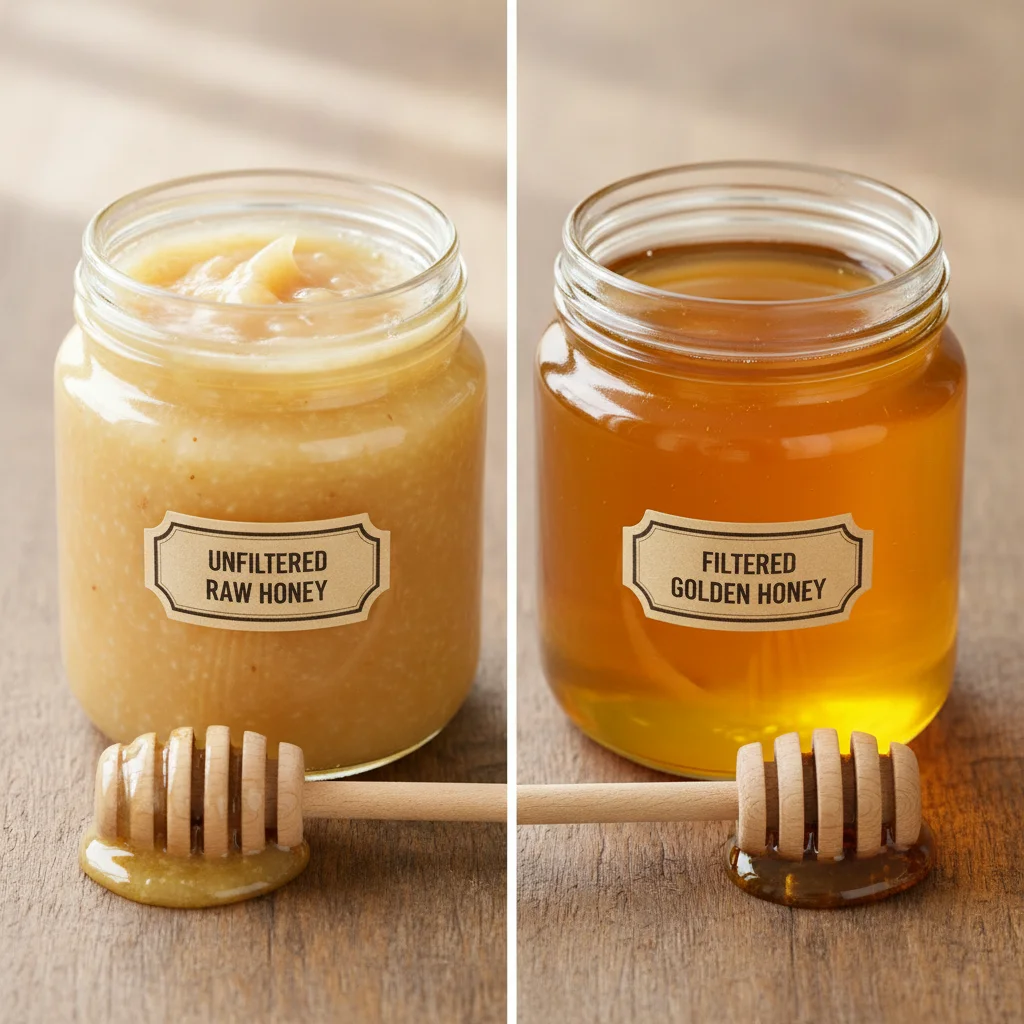
Key Differences: Filtered vs Unfiltered Honey
To clearly see the distinctions, the following table outlines the primary differences between these two types of honey.
| Characteristic | Unfiltered (Raw) Honey | Filtered (Processed) Honey |
|---|---|---|
| Processing | Minimally processed; only coarse straining. | Heavily processed with fine filtration, often with heat. |
| Appearance | Cloudy, opaque, may contain visible particles. | Clear, bright, and visually uniform. |
| Texture | Likely to crystallize or solidify over time. | Stays liquid and smooth for extended periods. |
| Nutritional Content | Contains pollen, propolis, enzymes, and antioxidants. | Pollen and many micronutrients are removed. |
| Flavor Profile | Robust, complex, varies by region and flowers. | Consistent, purely sweet, less nuanced. |
| Shelf Life | Shorter; crystallization is natural but doesn’t spoil. | Longer commercial shelf life in a liquid state. |
| Common Uses | Drizzling, natural remedies, supporting local beekeepers. | General sweetening, baking, clear sauces, and retail. |
Nutritional and Health Considerations
The processing method directly influences the nutritional profile of honey. Unfiltered honey is celebrated for retaining bioactive compounds like bee pollen, which is rich in proteins and amino acids, and propolis, known for its antimicrobial properties. Additionally, it contains natural enzymes like diastase and invertase, which can aid digestion.
Conversely, the fine filtration and heat often used in processing filtered honey can degrade or remove these delicate compounds. Therefore, if you are seeking honey for its potential antioxidant properties or as a more holistic food, unfiltered honey is generally the superior choice. For more on the role of antioxidants in wellness, explore our guide on antioxidants for prostate health.
It is crucial to note, however, that honey is still a source of sugar and should be consumed in moderation regardless of type. Infants under one year should never consume any honey due to the risk of botulism.
Which One Should You Choose?
Your choice ultimately depends on your intended use and personal preferences.
Choose Unfiltered Honey If:
* You prioritize potential health benefits and natural enzymes.
* You enjoy distinct, terroir-driven flavors.
* You want to support local apiaries (most local honey is unfiltered).
* You are using it as a topping for yogurt, toast, or cheese.
Choose Filtered Honey If:
* You prefer a clear, liquid sweetener that won’t crystallize quickly.
* You need a consistent, neutral sweet flavor for baking or cooking.
* You are making a presentation-sensitive recipe, like a clear glaze or beverage.
* You are simply looking for an affordable, general-purpose sweetener.
For instance, if you’re experimenting with natural ingredients in your kitchen, you might find synergy between using pure honey and other wellness-focused items, such as horsetail plant tea.
How to Identify and Store Your Honey
Always read the label carefully. Look for terms like “raw,” “unfiltered,” or “unpasteurized” to identify less processed honey. “Pure honey” often indicates it has been filtered. True unfiltered honey may also have a label stating “contains pollen.”
For storage, keep honey in a sealed container at room temperature away from direct sunlight. Importantly, do not refrigerate it, as this accelerates crystallization. If your unfiltered honey crystallizes, you can gently warm the jar in a bowl of warm water to return it to a liquid state.
Final Verdict
Both filtered and unfiltered honey have their rightful place in the pantry. Unfiltered honey offers a more complex nutritional and flavor profile, making it ideal for direct consumption and natural wellness practices. Alternatively, filtered honey provides convenience, consistency, and clarity for cooking and baking.
Ultimately, the best honey is the one that aligns with your culinary needs and health goals. By understanding these key differences, you can make a more informed and satisfying choice for your table.


One thought on “Filtered vs Unfiltered Honey Guide”
Comments are closed.