
How an Ant Colony Works
How an Ant Colony Works: The Ultimate Superorganism
Have you ever watched a line of ants marching purposefully and wondered how such tiny creatures build empires? An ant colony is not just a group of insects; it’s a highly organized superorganism, where thousands of individuals work as a single, cohesive unit for the survival of the whole.
Understanding how an ant colony works reveals a world of sophisticated social structure, chemical communication, and collective problem-solving that rivals any human corporation. This intricate system ensures everything from finding food to raising young operates with flawless efficiency.
The Foundation: Colony Structure and Caste System
At the heart of how an ant colony works is a rigid social hierarchy, much like a well-oiled machine with specialized parts. Each ant has a specific role, determined by its caste.
The Reproductive Core: Queen and Drones
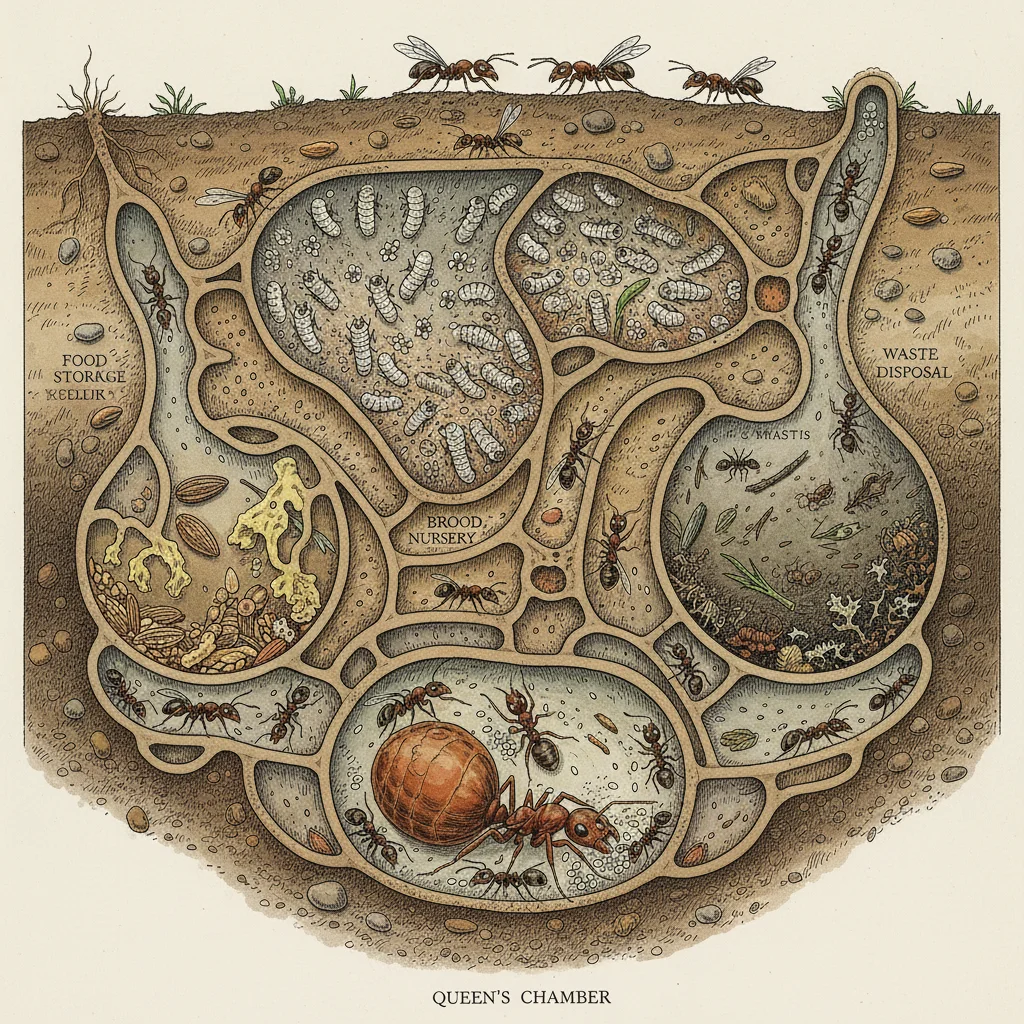
The colony’s existence hinges on the queen. Her primary, and often sole, function is reproduction. She can live for many years, laying thousands of eggs to ensure the colony’s growth and continuity. Consequently, she is the most protected and cared-for member. Drones are the male ants. Their only purpose is to mate with a new queen during a nuptial flight; after this, they typically die. This reproductive division of labor is the cornerstone of the colony’s longevity.
The Workforce: Female Workers and Soldiers
All worker and soldier ants are sterile females. They perform all the labor required for the colony to thrive. Moreover, workers often have sub-specialties:
* Nurses: Care for the queen and tend to the eggs, larvae, and pupae.
* Foragers: Venture outside the nest to search for food and water.
* Maintenance Workers: Excavate and repair the nest’s intricate tunnel systems.
* Soldiers: Defend the nest with their larger size and powerful mandibles.
This caste system creates a perfectly balanced society where every task, from defense to childcare, is expertly managed.
Communication: The Chemical Language of Pheromones
The seamless coordination you observe is powered by chemistry. Ants communicate primarily through pheromones—scent chemicals they secrete and detect with their antennae. This chemical language dictates nearly every colony behavior.
- Trail Pheromones: When a forager finds food, she lays a chemical trail back to the nest. Other workers then follow this scent highway to the source, reinforcing the trail as they return. This creates the iconic marching lines.
- Alarm Pheromones: If the nest is threatened, a soldier releases a different pheromone that triggers an immediate defensive response from nearby ants.
- Queen Pheromones: The queen’s unique scent signals her health and fertility, which suppresses the reproductive ability of worker females and maintains social harmony.
Therefore, the colony operates like a distributed network, with pheromones serving as the data packets that guide collective action.
The Colony Life Cycle: From Founding to Maturity
Understanding how an ant colony works requires following its life cycle, which is a remarkable story of risk and renewal.
- Nuptial Flight: Mature colonies produce new queens and drones. They take to the air in a synchronized swarm to mate.
- Colony Founding: After mating, a new queen lands, sheds her wings, and digs a small chamber. She then seals herself in and lays her first batch of eggs, surviving on her own metabolized wing muscles.
- The First Brood: The queen feeds this first generation of larvae. When they mature into worker ants, they break open the chamber and begin foraging, finally feeding their queen.
- Growth and Maturity: The colony expands rapidly as the queen focuses solely on laying eggs. The workforce grows, and the nest becomes more complex.
- Reproduction and Swarming: Once the colony is stable and large, it will produce its own reproductive ants to start the cycle anew.
Collective Intelligence and Problem-Solving
Perhaps the most fascinating aspect of how an ant colony works is its emergent collective intelligence. No single ant directs traffic or makes complex decisions. Instead, simple interactions between individuals following basic rules (like “follow the strongest pheromone trail”) lead to sophisticated colony-wide behavior.
For instance, when finding the shortest path to food, ants leaving a stronger pheromone trail on a shorter route will attract more followers, which further strengthens that trail. The longer, weaker trails eventually evaporate. This is a form of decentralized optimization that humans study for logistics and network design. Similarly, their ability to assign tasks dynamically based on colony needs—like more nurses when brood is abundant, or more foragers when food is scarce—shows an adaptive intelligence.
The Colony as a Single Entity
Ultimately, an ant colony functions as a superorganism. The queen acts as the reproductive organ, the workers as the limbs and gut, and the pheromone trails as the nervous system. The individuals cannot survive long alone; their meaning and function exist only within the colony. This perspective helps explain their self-sacrificing behaviors, such as workers fighting to the death to protect the nest. Their survival strategy is not individual, but collective.
For further reading on complex biological systems and health, explore our guide on the best brain health supplements, which discusses supporting another intricate network—your own mind. Additionally, the colony’s efficient resource gathering and storage is a natural parallel to human endeavors like planning and nutrition, much like the considerations in our article on the 9 vegan keto diet plans.
In conclusion, the question of how an ant colony works unveils a masterpiece of natural engineering. Through specialized castes, a chemical language, and swarm intelligence, these tiny insects build resilient societies that have thrived for over 100 million years. Observing an ant colony offers a profound lesson in teamwork, communication, and the incredible results of collective effort.

