
Halal vs Kosher: Key Differences
Is Halal the Same as Kosher? A Clear Guide to Dietary Laws
If you’re navigating food labels, exploring different cuisines, or simply curious about religious dietary practices, you’ve likely encountered the terms “halal” and “kosher.” A common question arises: are they the same thing? While both represent sacred food laws in Islam and Judaism respectively, and share some philosophical similarities, they are distinct systems with unique rules. Understanding these differences is crucial for making informed dietary choices and respecting religious traditions.
Fundamentally, halal is not the same as kosher. They are governed by different religious authorities, textual sources, and specific regulations. However, there is significant overlap, which often leads to confusion. This guide will provide a clear comparison, breaking down the key similarities and differences to give you a comprehensive understanding.
Core Similarities Between Halal and Kosher
Firstly, it’s helpful to recognize where these two dietary laws align. Both halal (permissible in Islam) and kosher (fit or proper in Judaism) originate from divine commandment and share a core principle: conscious, mindful eating that connects consumption to faith.
- Prohibition of Pork: Both systems strictly forbid the consumption of pork and pork by-products.
- Blood Restriction: Consuming blood is prohibited in both Islamic and Jewish law. Consequently, both require specific slaughter methods to drain blood from the animal.
- Slaughter Method: The rituals of slaughter (dhabiha for halal, shechita for kosher) involve a swift, deep cut to the throat with a sharp knife by a trained practitioner, intended to minimize animal suffering.
- Blessing Requirement: Each slaughter must be performed with a dedicated blessing, invoking the name of God (Allah for halal, Hashem for kosher).
Key Differences: Halal vs. Kosher
Despite the similarities, the differences are substantial and govern everything from permitted animals to food preparation. The table below outlines the major distinctions.
| Aspect | Halal (Islamic Law) | Kosher (Jewish Law) |
|---|---|---|
| Source of Law | Derived from the Quran, Hadith (sayings of Prophet Muhammad), and scholarly consensus. | Derived from the Torah (Written Law) and the Talmud (Oral Law). |
| Blessing at Slaughter | Must specifically invoke the name of Allah. The name of God must be pronounced for each animal or group. | A blessing is recited at the start of a slaughtering session, covering all animals processed. |
| Permitted Animals | All carnivorous animals and birds of prey are forbidden. Permitted animals must chew cud and have cloven hooves (e.g., cows, sheep, goats). | Requires specific signs for land animals (cloven hooves and chewing cud) and a list of permitted birds. No requirement for both criteria beyond the Torah’s list. |
| Seafood | All fish with scales are halal. There is debate among schools of thought regarding shellfish, but many consider it impermissible. | Only fish with both fins and scales are kosher. All shellfish (shrimp, lobster, crab) are forbidden. |
| Alcohol & Intoxicants | Strictly forbidden in any form, including in cooking or as a flavoring extract. | Permitted in certain contexts (like wine), but the wine itself must often be kosher-certified. Other alcohols are generally permitted. |
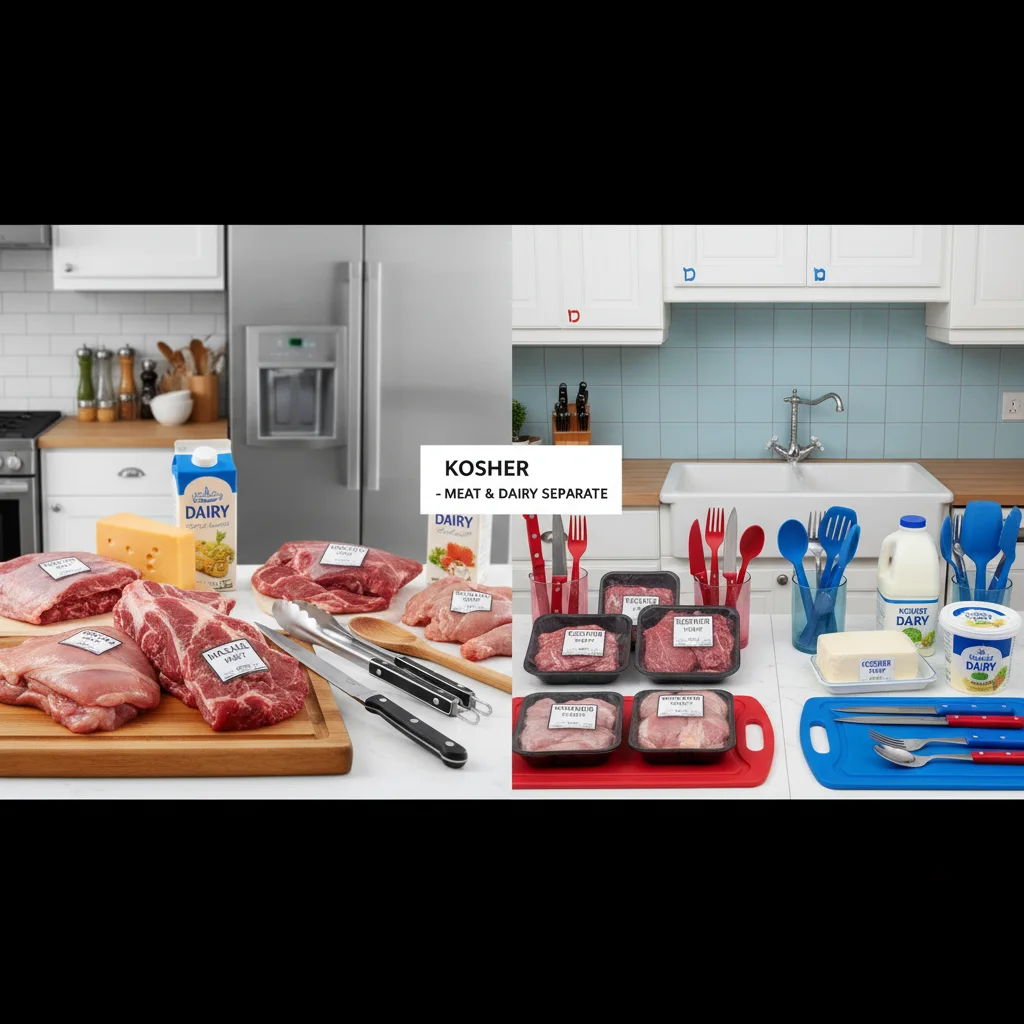
| Dairy & Meat Mixing | Permitted. There is no restriction on mixing meat and dairy products in Islamic law. | Strictly forbidden. Kosher law requires complete separation of meat and dairy, including using separate utensils, cookware, and waiting periods between consumption. |
| Certification & Supervision | Performed by Islamic organizations. A halal certifier must be Muslim. | Performed by rabbinical authorities or kosher certification agencies. A mashgiach (supervisor) is often required. |
The Slaughter Process: A Deeper Dive
The slaughter rituals are a central point of comparison. For halal, the animal must be healthy at the time of slaughter and the cut must sever the trachea, esophagus, and both jugular veins. The name of Allah must be invoked. For kosher shechita, the cut must be made with a perfectly smooth, sharp blade in a single, uninterrupted motion by a trained shochet. The blessing is recited at the start. Notably, an animal slaughtered by a Jewish shochet for kosher purposes is not automatically halal for Muslims because the blessing does not invoke Allah. Conversely, meat slaughtered by a Muslim may not meet all the precise criteria required for kosher certification.
What About Cross-Over Consumption?
This is where it gets practical. Can a Muslim eat kosher food, or can a Jewish person eat halal food?
* For Muslims: Kosher meat is generally not acceptable as halal because the name of Allah was not invoked at slaughter. However, kosher products that are purely vegetarian, seafood (with scales), or dairy are often considered permissible by many scholars, provided they contain no forbidden ingredients like alcohol. Always check with a knowledgeable authority.
* For Jewish Observance: Halal meat is not kosher. The slaughter was not performed by a shochet under rabbinical supervision, and it does not comply with the intricate laws of shechita. Furthermore, the strict separation of meat and dairy is not guaranteed in a halal kitchen.
Practical Guidance for Consumers
When shopping or dining out, look for official certification labels from recognized bodies (e.g., IFANCA for halal, OU, OK, or Kof-K for kosher). Do not rely on the terms alone. If you have specific health-related dietary goals, such as managing blood sugar, understanding ingredient sourcing is key. For instance, exploring guides on blood sugar levels can complement your dietary planning, regardless of religious practice.
Moreover, if you are managing other health conditions, such as prostate health, your dietary focus might intersect with these laws. For example, when seeking out antioxidants for prostate health, you would need to ensure any supplements or recommended foods also align with halal or kosher standards.
In conclusion, while halal and kosher dietary laws share a common Abrahamic heritage and several important rules, they are distinct religious practices with non-interchangeable requirements. The most significant differences lie in the permissibility of alcohol, the mixing of meat and dairy, and the specific theological requirements of the slaughter blessing. Therefore, they are not the same, and products certified for one are not automatically compliant with the other. Understanding these nuances fosters greater cultural respect and enables informed personal choice.

