
Air Squats: Form, Benefits & Mistakes
Air Squats: The Ultimate Guide to Mastering the Foundational Movement
The air squat, also known as a bodyweight squat, is arguably the most fundamental human movement pattern. It forms the cornerstone of lower body strength, functional fitness, and overall mobility. Consequently, mastering this exercise is essential for everyone, from complete beginners to elite athletes. This comprehensive guide will break down everything you need to know about air squats, from their profound benefits to a step-by-step form guide and how to integrate them into your routine.
What Are Air Squats? 🏋️
An air squat is a strength exercise where you lower your hips from a standing position and then stand back up, using only your body weight for resistance. Unlike barbell back squats or goblet squats, it requires no equipment. Therefore, it’s an incredibly accessible movement that can be performed anywhere. Its primary purpose is to build foundational strength in the quadriceps, hamstrings, glutes, and core, while simultaneously improving joint mobility and stability.
The Multifaceted Benefits of Air Squats
Incorporating air squats into your regular routine offers a wide array of physical benefits that extend far beyond building leg muscle.
1. Builds Foundational Lower Body Strength
Air squats effectively target all the major muscle groups in your lower body. The quadriceps on the front of your thighs, the hamstrings and glutes on the backside, and even the calves are engaged during the movement. This creates a strong, stable base for all other physical activities, from running to lifting groceries.
2. Enhances Functional Mobility and Joint Health
Squatting is a movement we use daily—sitting down, standing up, or picking something up from the floor. Regularly performing air squats helps maintain and improve the mobility of your ankles, knees, and hips. Moreover, it promotes synovial fluid circulation in the joints, which can help keep them lubricated and healthy.
3. Improves Core Stability and Posture
A proper air squat is not just a leg exercise; it’s a full-body engagement. To maintain an upright torso and a neutral spine, your abdominal muscles, obliques, and lower back muscles must work isometrically. This constant tension builds a stronger core, which is crucial for good posture and preventing lower back pain.
4. Boosts Caloric Burn and Metabolic Rate
Because air squats engage large muscle groups, they are a highly efficient metabolic exercise. Performing them in higher repetitions or as part of a circuit can elevate your heart rate and increase caloric expenditure both during and after your workout, a phenomenon known as Excess Post-Exercise Oxygen Consumption (EPOC).
5. Accessible and Scalable for All Fitness Levels
The greatest advantage of the air squat is its scalability. Beginners can perform a partial squat to a box, while advanced athletes can aim for deep, controlled repetitions or add tempo. This makes it a lifelong tool for fitness progression.
Perfecting Your Air Squat Form: A Step-by-Step Guide
Executing an air squat with proper form is critical to reaping its benefits and avoiding injury. Follow these steps closely.
Starting Position:
1. Stand with your feet roughly shoulder-width apart. Your toes can point slightly outward.
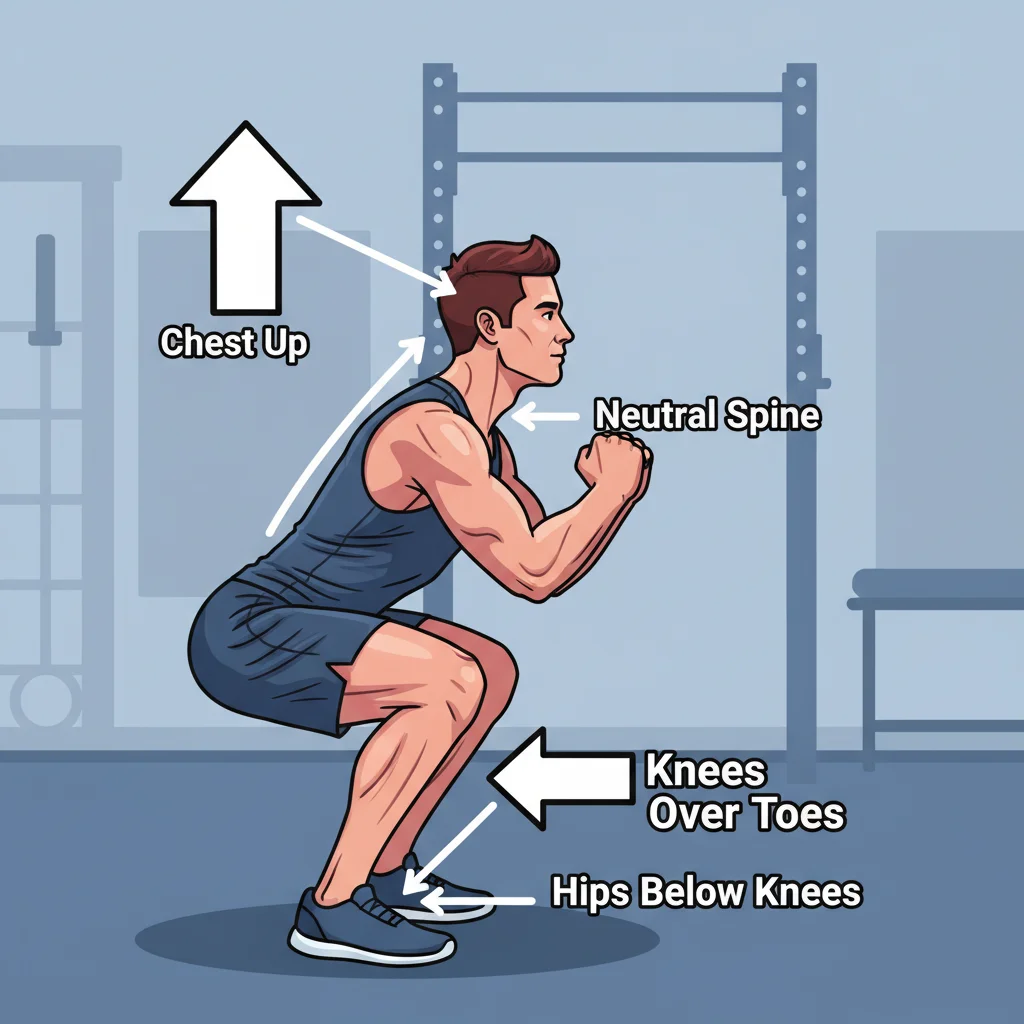
2. Keep your chest up, shoulders back, and gaze forward. Engage your core.
The Descent (Eccentric Phase):
1. Initiate the movement by pushing your hips back as if you are sitting in a chair.
2. Simultaneously, bend your knees and lower your body. Aim to get your hips at or below knee level.
3. Keep your knees tracking in line with your toes—do not let them cave inward.
4. Maintain a neutral spine; do not round your lower back.
5. Your torso will naturally lean forward slightly, but your chest should stay up.
The Ascent (Concentric Phase):
1. Drive through your entire foot—heels, balls, and toes—to stand back up.
2. Push the floor away from you and squeeze your glutes at the top to achieve full hip extension.
3. Return to the starting position with control.
Common Air Squat Mistakes and How to Fix Them
Even a simple movement like the air squat has common pitfalls. Here’s how to identify and correct them.
| Mistake | Consequence | Correction |
|---|---|---|
| Knees Caving In | Places undue stress on knee ligaments and can lead to injury. | Focus on “screwing” your feet into the floor to engage glutes. You can also use a mini-band above your knees for feedback. |
| Heels Lifting Off Ground | Reduces power, shifts stress to knees, and compromises balance. | Work on ankle mobility. Practice squatting with your heels on a small plate or perform drills like the Goblet Squat to learn weight distribution. |
| Rounding the Lower Back (Butt Wink) | Can compress spinal discs and lead to back pain. | This is often a mobility issue. Focus on bracing your core tightly and avoid squatting deeper than your mobility allows. Incorporate hip and ankle mobility drills. |
| Insufficient Depth | Limits full range of motion benefits and glute activation. | Use a box or bench as a target to squat to. This provides a tactile cue and builds confidence in the bottom position. |
How to Incorporate Air Squats Into Your Routine
Air squats are incredibly versatile. Here are a few effective ways to add them to your fitness plan:
- As a Warm-Up: Perform 2-3 sets of 10-15 reps to increase blood flow and prepare your muscles and joints for a workout.
- As a Standalone Strength Exercise: Aim for 3-5 sets of 15-25 reps to build muscular endurance. Focus on perfect form throughout.
- In a Circuit or HIIT Workout: Combine air squats with push-ups, planks, and lunges in a timed circuit for a full-body, metabolic conditioning session.
- For Skill Practice: Perform “pistol squats” (single-leg squats) or overhead squats with a broomstick to challenge balance and mobility, using the air squat as your foundational skill.
Furthermore, building a strong foundation with bodyweight movements like the air squat can complement other health goals, such as following specialized vegan keto diet plans for weight management.
The Bottom Line: Squat for Life
The air squat is more than just an exercise; it’s a fundamental expression of human strength and mobility. By mastering its form and integrating it consistently into your routine, you build a resilient body capable of handling daily life with ease. Start with quality over quantity, listen to your body, and progressively challenge yourself. Your future self will thank you for maintaining this simple, powerful practice.
Disclaimer: This article is for informational purposes only and is not a substitute for professional medical advice. Always consult with a healthcare provider before beginning any new exercise program, especially if you have pre-existing conditions. For more information on exercise science, you can refer to resources like the National Institute of Arthritis and Musculoskeletal and Skin Diseases (NIH).

