
Halal vs Kosher Meat Differences
Halal Meat vs Kosher: Understanding Religious Dietary Laws
Navigating the world of religious dietary laws can be complex. Two of the most well-known systems are Halal, observed in Islam, and Kosher, observed in Judaism. While both emphasize humane treatment and specific slaughter methods, their rules and spiritual foundations are distinct. This guide breaks down the key differences to help you understand these important practices. Moreover, if you’re exploring other specific dietary guides, you might find our resource on blood sugar levels helpful for managing overall health.
What is Halal Meat?
Halal is an Arabic term meaning “permissible.” In the context of food, it refers to what is allowed under Islamic law (Sharia). The rules are derived from the Quran, the Hadith (sayings of the Prophet Muhammad), and scholarly consensus.
Core Principles of Halal Slaughter:
* Dedication to God: The slaughter must be performed by a sane adult Muslim who invokes the name of Allah (God) at the moment of slaughter by saying “Bismillah” (In the name of God).
* Animal Welfare: The animal must be alive and healthy at the time of slaughter.
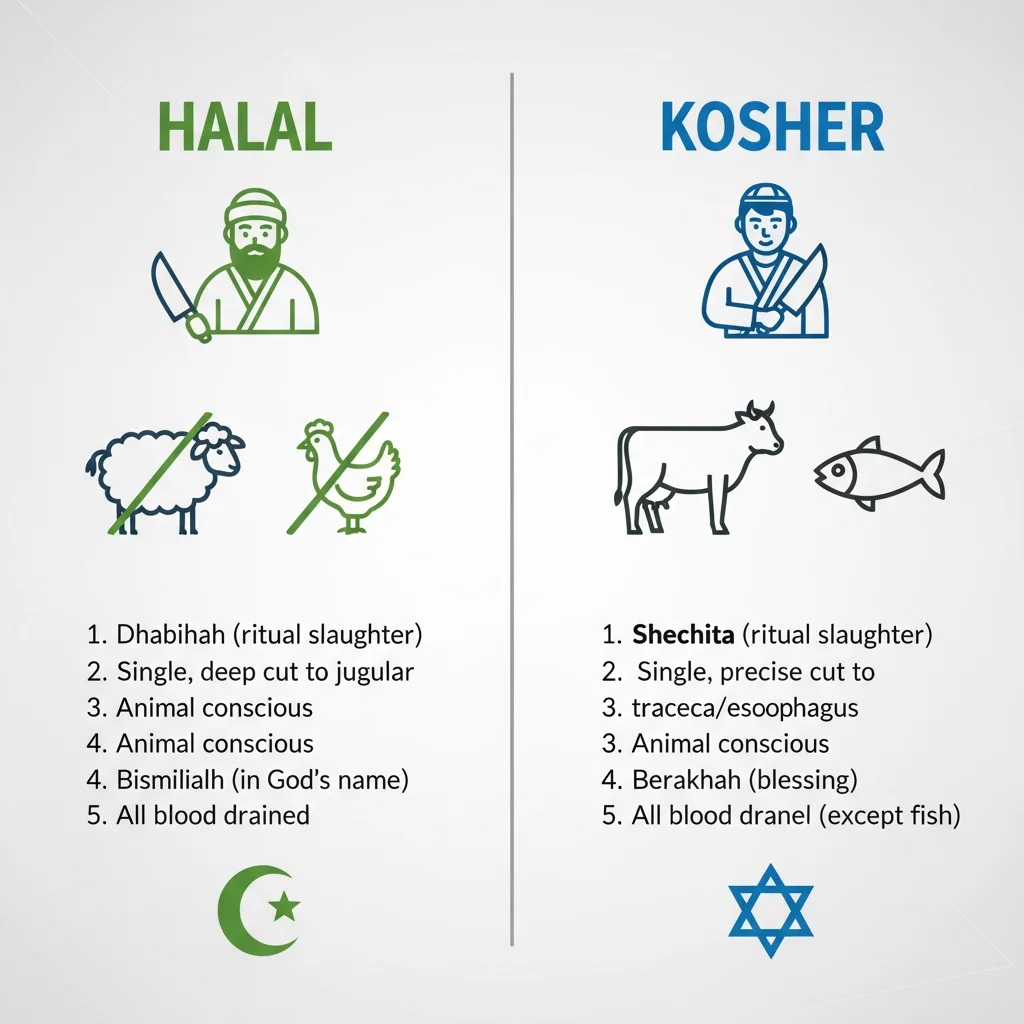
* Method of Slaughter: A swift, deep cut with a sharp knife to the throat, severing the trachea, esophagus, and carotid arteries to ensure rapid blood drainage and minimize suffering.
* Prohibited Substances: Consuming blood, pork, carnivorous animals, and alcohol is strictly forbidden.
What is Kosher Meat?
Kosher (or “kashrut”) refers to the set of Jewish dietary laws. These laws are extensive and come from the Torah (the Hebrew Bible), specifically the books of Leviticus and Deuteronomy.
Core Principles of Kosher Slaughter (Shechita):
* Qualified Slaughterer: The act must be performed by a highly trained and certified Jewish individual known as a “shochet.”
* Precise Technique: Using an impeccably sharp, smooth blade (a “chalef”), the shochet makes a single, uninterrupted cut across the throat. This method is designed for instantaneous loss of consciousness.
* Post-Slaughter Inspection: The animal’s lungs and other organs are carefully examined for any defects or adhesions that would render the meat non-kosher (“treif”).
* Prohibition of Blood & Mixing: All blood must be removed through a process of soaking and salting (melicha). Furthermore, meat and dairy products cannot be mixed in cooking, eating, or even using the same utensils.
Halal vs Kosher: Key Differences Compared
While they share similarities in emphasizing humane slaughter and blood drainage, several critical distinctions set them apart.
| Feature | Halal Meat | Kosher Meat |
|---|---|---|
| Religious Origin | Islamic Law (Sharia) | Jewish Law (Kashrut) |
| Key Scriptural Source | The Quran | The Torah |
| Pronouncement at Slaughter | Required (“Bismillah”) | A blessing is recited, but not necessarily on each animal. |
| Who Can Perform Slaughter | A sane adult Muslim | A specially trained Jewish shochet |
| Pre-Slaughter Stunning | Debated. Some certifying bodies permit reversible stunning if it doesn’t kill the animal; others prohibit it entirely. | Generally Not Permitted. Traditional shechita forbids any form of pre-stunning. |
| Animal Inspection | Focus on animal being healthy and alive. Less formalized post-cut inspection. | Stringent. Mandatory internal inspection (especially of lungs) for defects. |
| Prohibition on Mixing | No prohibition on mixing meat and dairy. | Strict separation of meat and dairy products and utensils. |
| Alcohol in Cooking | Forbidden. | Permitted, as long as all other ingredients are kosher. |
Can Muslims Eat Kosher Meat? (And Vice Versa?)
This is a common question with a nuanced answer.
- For Muslims: Many Islamic scholars hold that Muslims may eat kosher meat in the absence of halal options, primarily because the name of God is invoked during Jewish slaughter. However, the prohibition of alcohol in Islam creates a complication, as alcohol can be used in kosher food preparation. Consequently, many Muslims seek specifically halal-certified products to be certain. For those managing specific health conditions alongside dietary laws, understanding ingredients is key, similar to knowing the nutritional value of graham crackers for a balanced diet.
- For Jewish People: Kosher laws are generally more restrictive. Kosher-observant Jews cannot eat halal meat unless it also has a reliable kosher certification. The main reasons are the lack of a shochet and the absence of the specific post-slaughter inspections required by kashrut.
Choosing for Your Diet: Health, Ethics, and Availability
When deciding between halal and kosher products, consider your personal priorities:
- Religious Observance: This is the primary factor for followers of Islam or Judaism. Always follow the guidance of your religious authorities.
- Animal Welfare: Both methods prioritize a quick death. The debate often centers on pre-slaughter stunning. If this is a major concern, research the specific certification on the product (e.g., some halal certifiers allow reversible stunning).
- Health Perceptions: The extensive blood drainage in both methods is believed by some to result in cleaner, less porous meat. While research is ongoing, the focus on animal health at slaughter can be seen as a benefit.
- Availability: Halal meat is often more widely available in general supermarkets, while kosher meat is typically found in specialty kosher markets or sections.
Conclusion: Respecting Different Paths
Ultimately, both halal and kosher dietary laws are profound expressions of faith, mindfulness, and discipline. They encourage followers to be conscious of what they consume, from its source to its preparation. While their rules differ in execution, they share a common core of respecting life, promoting hygiene, and connecting daily sustenance to spiritual practice.
Understanding these differences fosters greater cultural and religious appreciation. For those interested in other aspects of mindful consumption and natural remedies, exploring options like the best tea for a sore throat can complement a holistic approach to well-being.

